
RentSpreeProduct design · 2022
Agent Reviews
Helping new agents build credibility through client feedback.
New agents needed more than a profile to earn a client’s trust. I designed RentSpree’s first Agent Reviews experience, connecting rental applications and shareable review links to feedback on agent profiles.
- Role
- Product Designer · UX & UI
- Company
- RentSpree
- Timeline
- About 2 months · 2022
- Scope
- Desktop & mobile
- The challenge
- Help agents build credibility, even when they have few renters on the platform.
- My contribution
- Designed the user flows, wireframes, and UI based on research led by my UX researcher colleague. Proposed the shareable recommendation link to help agents collect feedback from past clients and coworkers.
- The result
- MVP launched. Early feedback suggested agents updated their profiles after receiving reviews; long-term impact was not measured during my time.
My contribution
From research direction to a shipped feature.
I owned the user flows, wireframes, and desktop and mobile UI over roughly two months. My UX researcher colleague established the direction: use reviews to help new agents build credibility.
I compared existing review products and worked through the design decisions with the researcher, stakeholders, and UX lead. The three decisions below shaped the MVP.
The problem
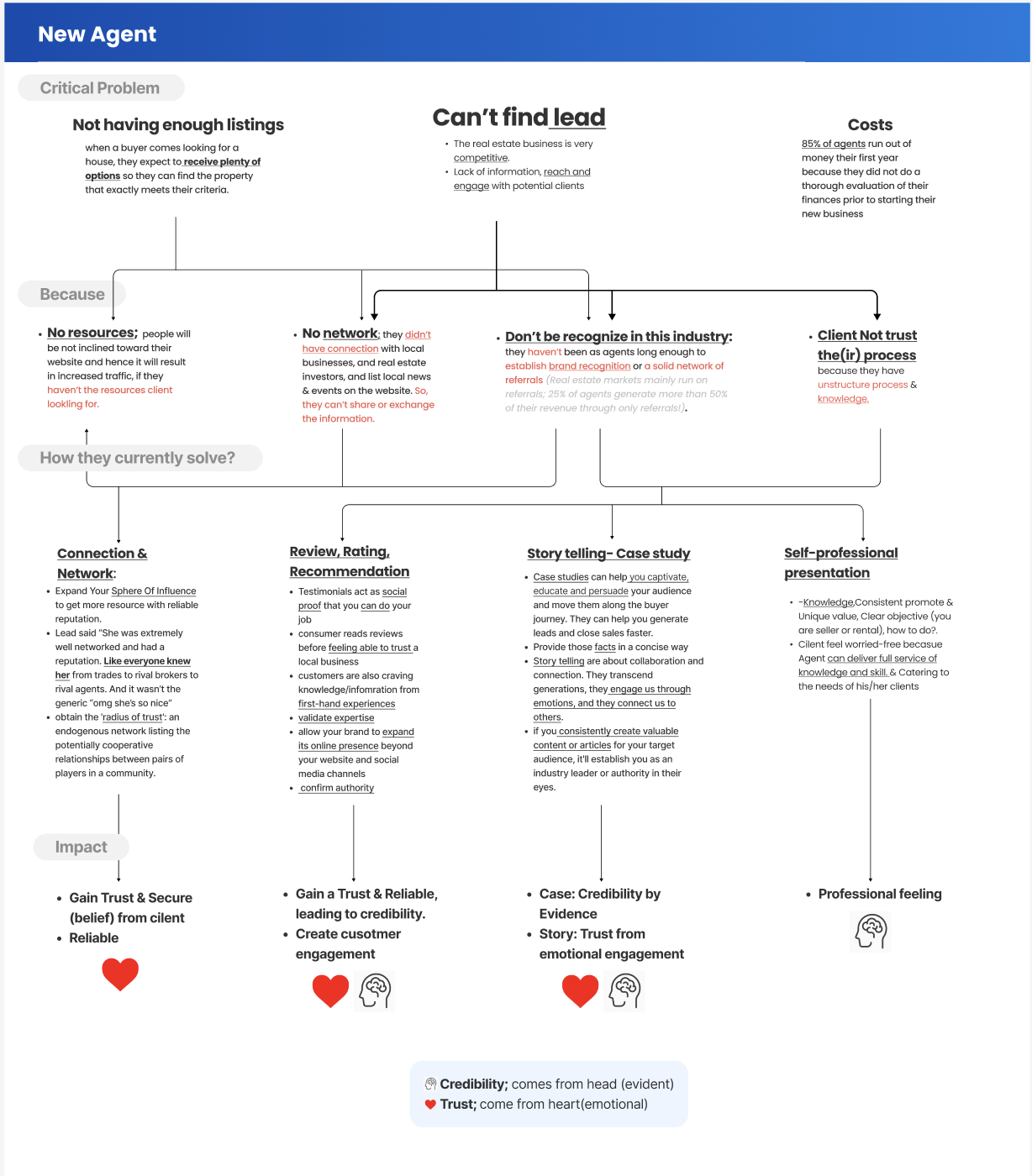
New agents needed a way to demonstrate credibility.
Clients needed evidence to feel confident choosing an agent. New agents had little evidence of their experience to share.
My colleague, a UX researcher, led the research and synthesis that informed my design work.
- Few connections
- A limited local network meant fewer opportunities to reach clients and exchange useful information.
- Little recognition
- New agents had not yet established the reputation or referral network that helps experienced agents attract clients.
- Low client confidence
- Clients had little evidence of an agent’s knowledge or approach to help them make a choice.
The research mapped these barriers to ways of building credibility through evidence and trust through experience—including networking, reviews, case studies, and professional presentation.
From research to design
Let clients’ experiences speak for the agent.
My design response was to make those experiences visible on the agent’s profile, giving future clients more than an agent’s own description to rely on.
Turning that direction into a feature
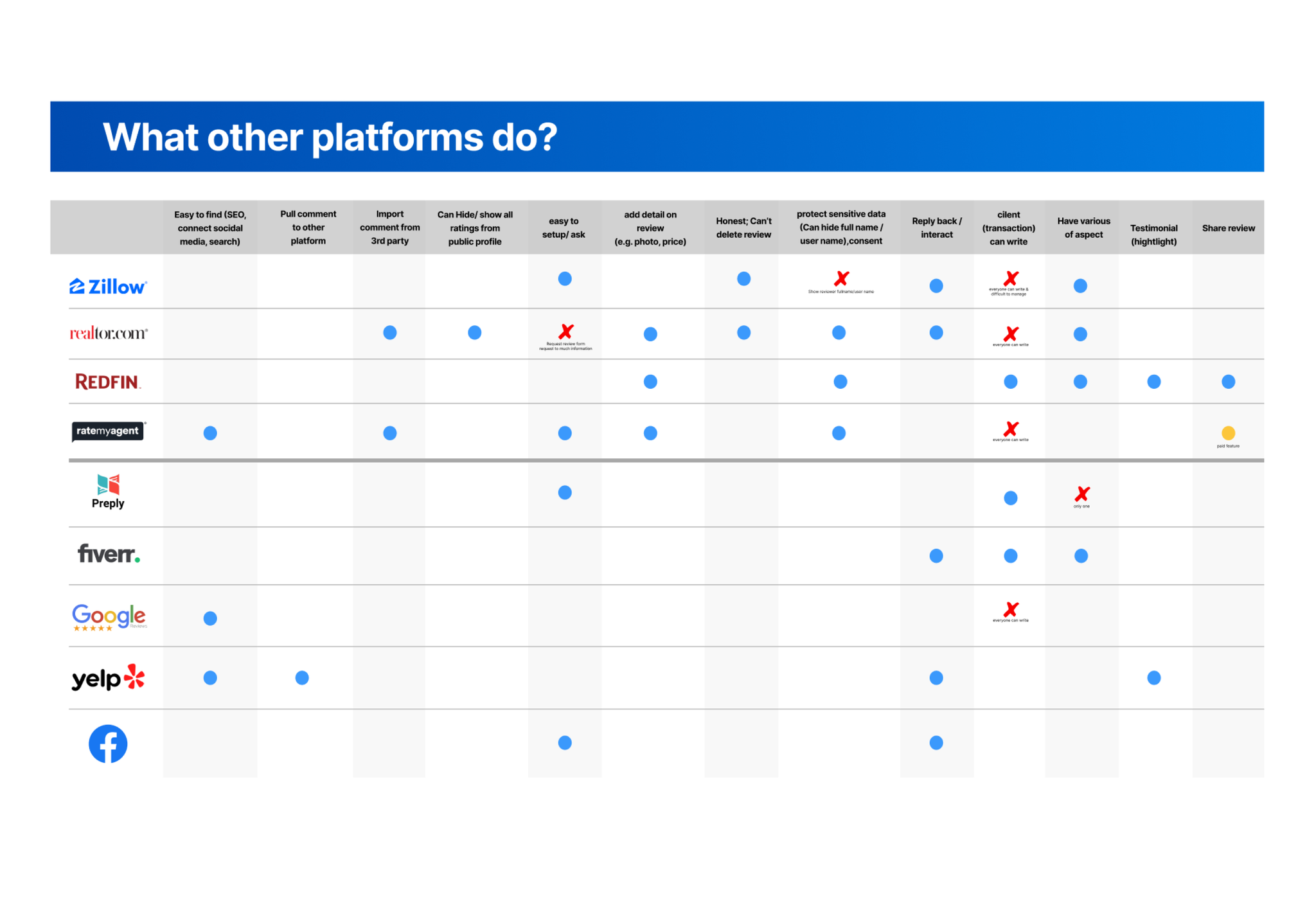
I compared how real estate and service platforms collect and display feedback to inform the review experience.
Decision 01 · When to ask
Ask after the application is submitted.
By the time renters reached RentSpree’s application form, they had usually spoken with the agent and experienced offline steps such as property viewings. That made a completed application a useful moment to ask about their experience, even though it did not mean the lease was complete.
Ask after application submission
This was a digital touchpoint we could use after renters and agents had already worked together. Application volume offered a way to collect initial reviews.
Why not wait for a completed lease?
We could collect feedback earlier. A second request after leasing, with a review-stage label, remained a plan for the next phase.
Decision 02 · Collecting first reviews
Give agents another way to collect their first reviews.
The hardest problem was that some agents worked with few renters on RentSpree. They could have experience and past clients, but few opportunities to collect feedback through our application flow.
I proposed a shareable recommendation link that agents could send to past clients or coworkers. This launched in the MVP as a standalone review page, using a similar layout to the review modal.
Launch limitation: one review per email address, per agent. This limited repeat submissions but did not verify the reviewer’s relationship to the agent. Recommendation and application reviews had no source labels.
Decision 03 · The transparency tradeoff
I advocated written feedback at every rating.
What I recommended
The researcher and I advocated written feedback at every rating. Restricting negative written reviews could make the feedback less credible to people choosing an agent.
What shipped
The CEO was concerned that harsh reviews could discourage new agents. Stakeholders and the UX lead supported a launch restriction: 1–2 stars counted toward the score, but only 3–5 stars allowed written feedback.
What the review sessions revealed
An ex-agent employed by RentSpree reviewed the flow with us and questioned why the text field disappeared at 1–2 stars. They accepted trying it for the early release after stakeholder discussions. This was internal feedback, not broad validation from renters.
The MVP did not explain the missing field. The decision allowed us to launch, but left the transparency concern unresolved. Opening written feedback to all ratings was planned for a later phase.
How it works
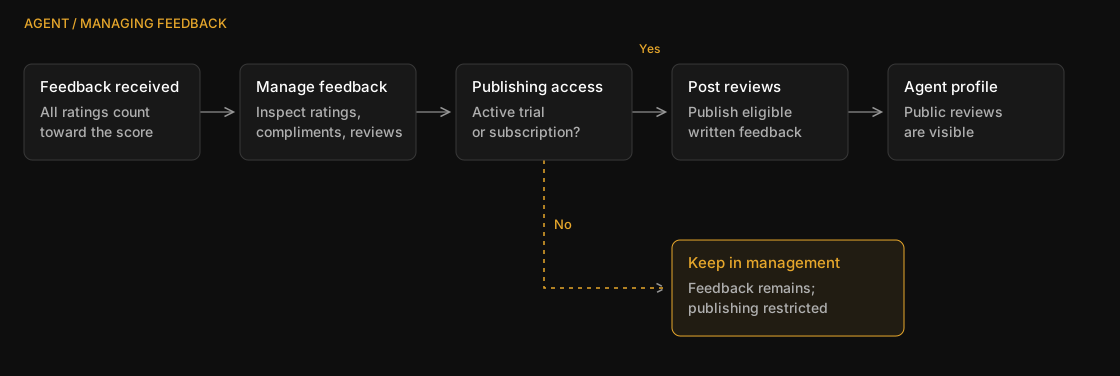
Renters leave feedback. Agents manage it.
I designed both sides: how renters submit feedback and how agents manage and publish reviews.
- RenterRate & submit
- AgentReview & manage
- Agent ProfilePublish & display
User flows
Leaving a review
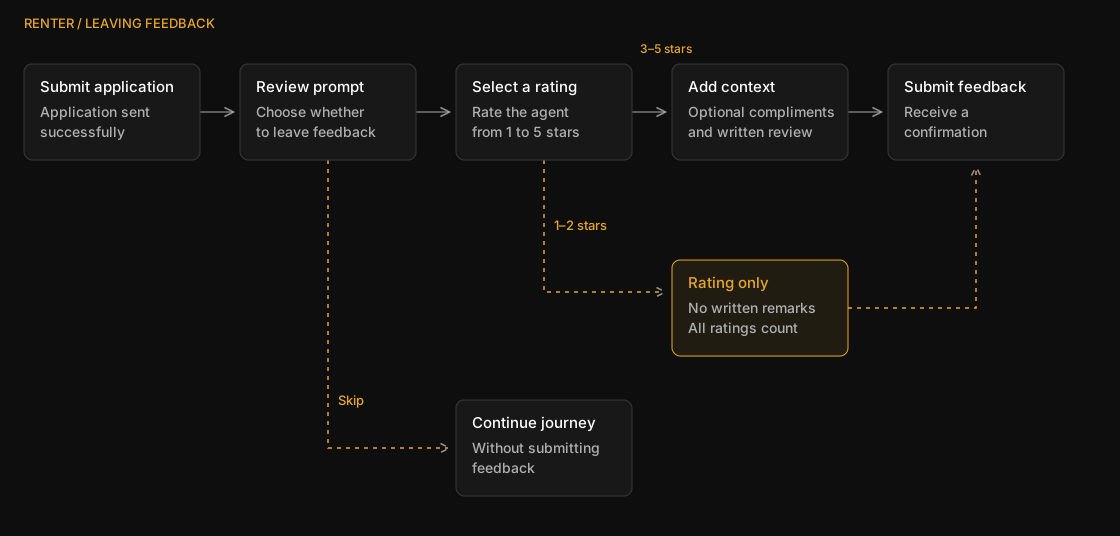
A rating, quick compliments, and a written review.
Renters can give feedback in one place:
- 01
Rate the experience
Choose a rating from 1 to 5 stars.
- 02
Choose compliments
Highlight strengths such as communication or market knowledge.
- 03
Add a written review
Describe your experience in your own words.
Feature rule: all ratings count toward the overall score. Ratings of 1–2 stars have no written-review field; ratings of 3–5 stars allow written feedback.
Agent review management
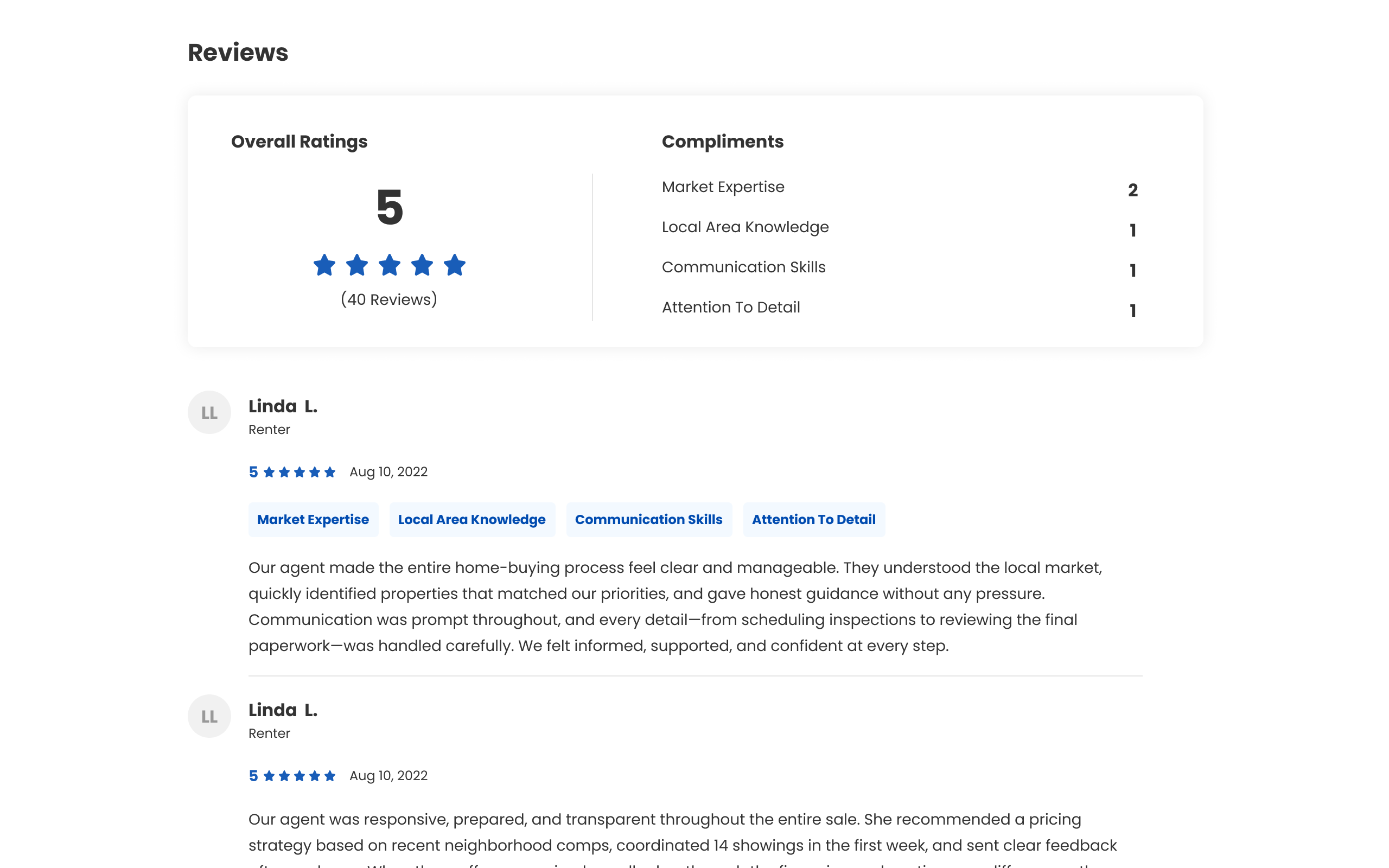
Showing reviews
See the rating first, then read the reviews.
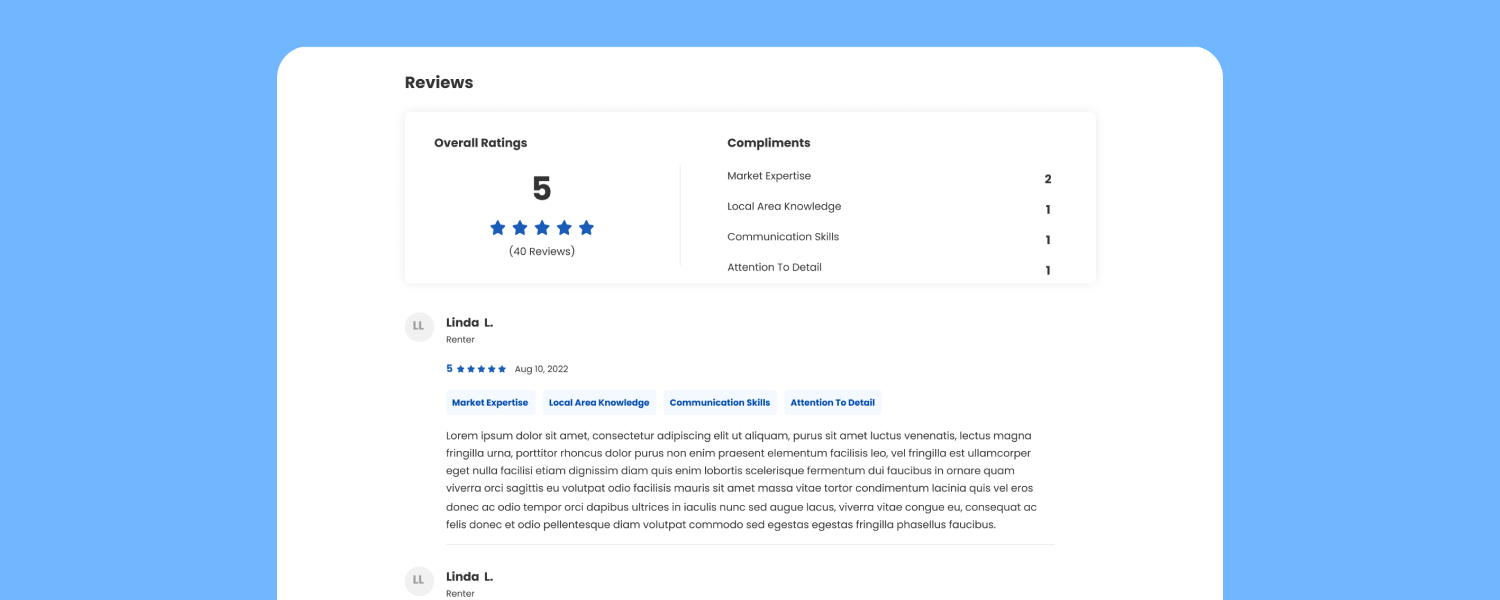
The profile shows the overall rating and compliments at the top, followed by individual client reviews.
Measurement plan
Would a first review encourage profile updates?
I defined the hypothesis and planned success metric, along with event-tracking requirements for the PM. We believed receiving a first client review would encourage agents to update or complete their profiles.
- Target: more than 30% within three days
- Of agents receiving their first review, more than 30% would update or complete their profile within three days of receipt. This was the planned target, not an observed result.
Looking back, reaching this target alone would not establish the review’s effect: some agents might have updated anyway. I would compare against a baseline and measure updates separately from completion among initially incomplete profiles.
A launched MVP and early signs of engagement.
We launched the post-application review request, shareable recommendation link, agent review management, and publishing to the Agent Profile.
- What we heard
- Early feedback suggested agents updated their profiles after receiving reviews—the behavior we hoped to encourage.
- What remains unmeasured
- I left before the next version and before seeing enough data to assess sustained impact. I cannot attribute an improvement in profile completion or conversion to this feature.
Reflection
Let every reviewer explain their rating.
If I returned to this feature, my first priority would be allowing written feedback at every rating. The purpose of reviews was to build credibility, and that required room for dissatisfied clients to describe their experience too.
The MVP balanced that goal against the business’s concern for new agents. I would revisit the restriction rather than treat it as a permanent rule.
Planned next phase
Collect feedback again after the lease is completed.
We planned a follow-up email after a renter was selected for the property and completed leasing. A new response would update the earlier review, and a stage label would distinguish feedback after application submission from feedback after completed leasing.
The follow-up email, updated review, and stage labels were future plans. They were not part of the version I launched.